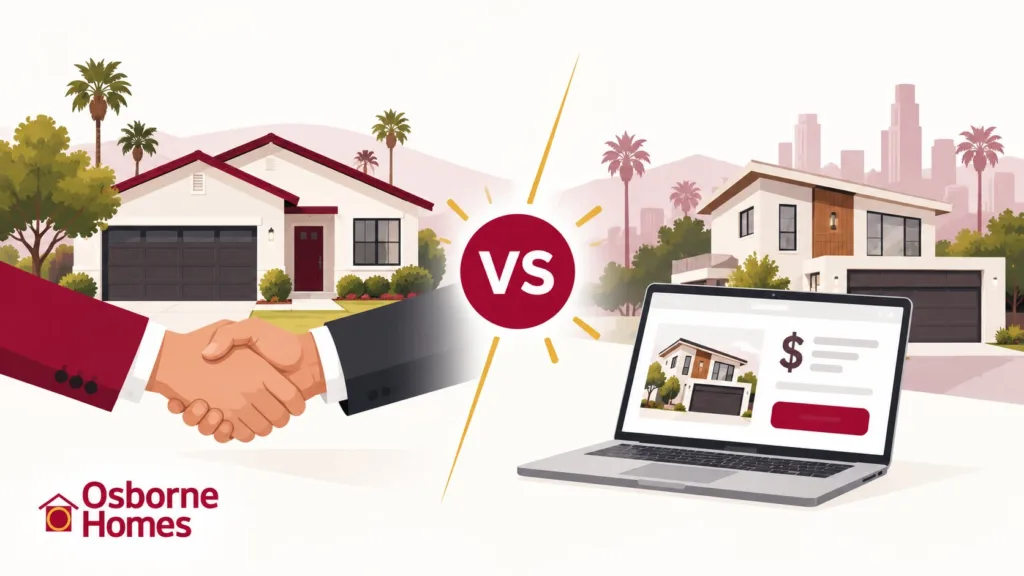
A direct buyer is a company or investor that buys a home with its own funds after assessing it individually, while an iBuyer is a technology company that makes algorithm-based cash offers on standard homes. In California, a direct buyer such as Osborne Homes will usually take a home in any condition and can close in as few as 7 days. An iBuyer may return an online offer sooner on a standard, market-ready home.
lightbulbKey Takeaways
Direct buyers assess each home individually and pay with their own funds, while iBuyers price standard homes by algorithm and buy them to resell.
check_circle
Opendoor says its model requires homes in standard resale condition, and fire damage, active mold or foundation failure make it a poor fit (June 2026).
check_circle
Offerpad’s published terms show a service fee of about 5% plus about 1% in closing costs, while Opendoor shows its fee only inside each offer.
check_circle
Cash-offer advertisers include investors who buy with their own money, wholesalers who pass the contract to another buyer, and marketplaces that share your details with a network. Only the investor is a direct buyer in the full sense.
check_circle
Opendoor and Offerpad publish close windows of about 8 to 60 days or more, while a direct sale can close in as few as 7 days.
check_circle
A home that needs repairs or must sell fast points to a direct buyer, while a clean home with time to spare can suit an iBuyer.
Which one suits a California seller depends on the house and the calendar. A home that needs work or a sale that must close fast points one way; a clean, market-ready home with time to spare points the other. An iBuyer is a technology company that values a home with software and buys it to resell. A direct buyer is a company or investor that pays with its own funds and closes the deal itself.
Zillow Offers wound down after a November 2021 announcement and Redfin shut down RedfinNow in November 2022, which leaves a short list of iBuyers still active in California. The sections below cover pricing, fees, the homes each buyer takes and closing speed. A side-by-side table follows, with a plain account of how one California direct buyer works.
An iBuyer builds its offer from an automated value estimate, which a pricing team then reviews. Opendoor says it compares the home with 100+ comparable sales in the seller’s ZIP code. The seller receives a preliminary offer online. A final offer follows after the company assesses the home’s condition, either from photos or at a visit.
The fees sit inside that process. Offerpad lists a 5% service fee plus about 1% in closing costs. Opendoor says its fee varies by market and property, appears in each offer and is not published as a fixed percentage; its own illustration on a $350,000 home uses a $17,500 service fee and about $3,500 in closing costs, labeled as an example only.
Repair credits come off the offer too. Opendoor’s examples run from $500 to $2,000 for minor items up to $8,000 to $20,000+ for major ones.
The model suits standard homes. Opendoor says it requires standard resale condition and that fire damage, active mold or foundation failure make it a poor fit. Offerpad says it buys as-is, with repair credits applied to the offer.
Keep in mind though, that only a few iBuyers make offers in California today, and their coverage is limited to certain metros and price ranges.
A direct buyer is a company or individual that buys a home with its own money and does not need a lender to complete the sale. The term covers three different business models:
Real estate investment companies buy with their own capital, inspect the property, price it as it stands and own the house at closing. Because the price already reflects the repairs, any condition is usually acceptable. No buyer’s mortgage approval stands between the offer and the closing.
Wholesalers work another way. They sign a contract with the seller, then look for a different buyer to take it over and keep the difference as a fee. Until that second buyer is found, the seller’s offer rests on the wholesaler’s ability to find one.
Marketplaces and lead-generation sites sit one step further back. They collect the seller’s details and pass them to a network of investors, so the seller may hear from several companies without knowing which one will close.
Before agreeing to anything, find out which type you are dealing with. Ask who will own the house at closing. Ask to see cash offer proof of funds in the buyer’s own name. Ask whether the contract can be assigned to someone else.
A real estate investment company will answer all three cleanly. Our guide on how to avoid we buy houses scams lists what else to check, and our page on how to sell to an investor walks through the process step by step.
This table compares how iBuyers and direct buyers work in California, using Osborne Homes as the example of a direct buyer. The iBuyer figures come from Opendoor’s and Offerpad’s own published terms, with dates below the table.
| Factor | Typical iBuyer | Osborne Homes |
| Offer basis | Automated estimate from comparable sales, reviewed by a pricing team, with a final offer after a condition assessment | Local walkthrough; priced on the property as it stands |
| Fees | Offerpad: about 5% service fee plus about 1% closing costs. Opendoor: fee shown only inside each offer | No commission or service fee; standard closing costs covered |
| Condition accepted | Opendoor: standard resale condition, poor fit for fire damage, active mold or foundation failure; repair credits from $500 to $2,000 (minor) up to $8,000 to $20,000+ (major). Offerpad: buys as-is, with repair credits | Any condition, as-is, including fire damage, mold and hoarder homes |
| Speed | Opendoor: offer within about 24 hours, close dates 21 to 60+ days out. Offerpad: close dates 8 to 60 days out | Close in as few as 7 days |
| Coverage area | Select California metros; varies by city and price range | Across California |
| Offer certainty | Preliminary offer first; final offer after assessment, with repair credits applied | Firm written cash offer after the walkthrough, with terms in writing |
Sources: Opendoor fees and repair credits (updated April 20, 2026); condition guidance (June 22, 2026); offer and closing timing; Offerpad’s fee and close window. Osborne terms per Osborne Homes. Terms change, so confirm them with each company before you decide.
Opendoor shows an offer within about 24 hours, and the two iBuyers let sellers choose a close date from about 8 to 60 or more days out, while a direct sale can close in as few as 7 days. On a $350,000 sale, Offerpad’s 5% service fee plus about 1% closing costs would take roughly $21,000 before any repair credits.
Osborne Homes is a California real estate investment company that has bought houses directly for cash, as-is, since 2007. As a real estate investment company, we act as the buyer itself, with no listing and no buyer financing to fall through.
The process has three steps:
The seller doesn’t repair, clean or stage anything, and we cover standard closing costs. Our No-Hassle Guarantee covers a firm written offer, no hidden fees and no last-minute reductions. If anything about the offer changes, we explain the change in writing before the seller decides.
Work through four checks in this order.
Long story short, if your house is not in standard resale condition, a direct buyer is a viable option – at least for the initial offer. Same applies if it’s a standard condition, but the sale must close in under three weeks.
If you’re not in a rush and your house doesn’t require extra work, collect one iBuyer offer and one direct offer, then compare what you keep.
A direct buyer pays with its own funds after assessing the home individually, while an iBuyer prices standard homes with software and buys them to resell. A direct buyer will usually take a home in any condition, and a sale can close in as few as 7 days. Opendoor requires standard resale condition, and Opendoor and Offerpad publish close windows of about 8 to 60 days or more.
Yes, a few iBuyers such as Opendoor still make offers in California, but their coverage is limited to certain metros and price ranges. Zillow Offers and RedfinNow both closed, in 2021 and 2022, so the field is smaller than it was. Enter your address on each company’s site to see whether your city and price range are covered.
Offerpad’s published fees total about 6%, made up of a 5% service fee plus about 1% in closing costs, while Opendoor shows its fee only inside each offer and direct-buyer fees vary by company. Osborne Homes charges no commission or service fee and covers standard closing costs. Ask every buyer for the breakdown in writing.
An iBuyer may buy a house with minor repairs, but it deducts repair credits, and it is a poor fit for major damage. Opendoor’s examples run from $500 to $2,000 for minor items up to $8,000 to $20,000+ for major ones, and Opendoor says fire damage, active mold or foundation failure make a home a poor fit. Direct buyers usually take these homes as-is.
Neither pays more in every case, because the better offer depends on the home’s condition and what the seller keeps after costs. On a standard, market-ready home, an iBuyer’s offer can be competitive before fees. On a home that needs work, a direct buyer’s price already reflects the repairs, so no repair-credit deduction follows.
Sometimes, because “we buy houses” is an advertising phrase that investors, wholesalers and lead-generation sites all use. Only a real estate investment company buys with its own funds and owns the house at closing, so ask who will own the property, whether proof of funds is in the buyer’s own name and whether the contract can be assigned.
A direct buyer’s offer can change if the walkthrough shows the home differs from what the seller described. Osborne Homes bases its cash offer on the walkthrough and puts all details in writing, and any change is explained in writing before the seller decides.
A seller who needs speed and a firm number should line up a direct cash sale against an iBuyer offer and a traditional listing, judged by what each leaves after fees and repair credits. Osborne Homes makes a no-obligation cash offer and can close in as few as 7 days. Want to see how much your house is worth (according to us)?
Fill out the quick form and get your cash offer today.
Osborne Homes is a real estate investment company, not a real estate agent or broker. This article is general information, not legal, tax or financial advice. Company terms and fees were checked on October 28, 2026 and can change.

The Osborne Homes Team
The Osborne Homes team specializes in California real estate, helping buyers, sellers, and homeowners navigate the market with clarity and confidence. Our articles are written to provide practical guidance, local insight, and up-to-date information you can trust.

Get a no-obligation cash offer in as little as 48 hours. No repairs, no agents, no stress. Just a dignified way to move forward.
Free property assessment. No obligation. No pressure.
sell