For an all-cash offer, sellers expect one of two things: a recent bank statement in PDF form or a bank-issued proof-of-funds letter on letterhead, showing your legal name, the account, the available balance, and a dated signature from a bank officer. A bank-signed letter typically carries more weight than a statement screenshot because it confirms the money is liquid, accessible, and free of holds.
| Pro Tip: Call your bank’s branch line instead of emailing a generic request. Ask specifically for a “verification of funds letter” for a real estate purchase. Branches with a signing officer on-site can often turn these around the same day, and agents trust them more than a downloaded statement because there’s a real person and phone number attached to the claim. |
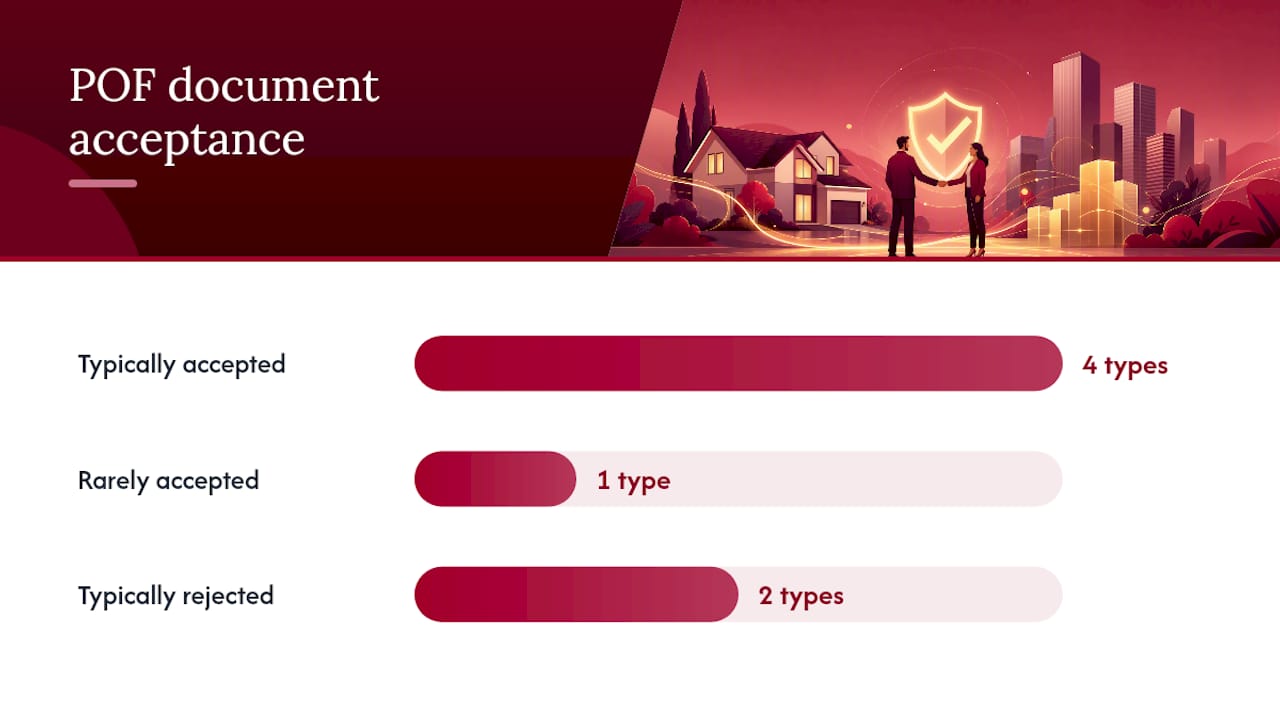
| Document Type | Typically Accepted? | Why |
|---|---|---|
| Bank statement PDF | Yes | Shows current balance directly from the institution |
| Bank-issued POF letter | Yes, often preferred | Signed, dated, and verifiable by phone |
| Cashier’s check / wire confirmation | Yes | Confirms funds are already mobilized |
| Brokerage cash confirmation | Yes, if uninvested | Proves funds are liquid, not tied up in holdings |
| Retirement account statement | Rarely | Requires withdrawal and tax penalty first |
| Screenshot of mobile app | No | Easily altered, no verification path |
| Borrowed “temporary” funds | No | Doesn’t reflect the buyer’s actual capacity |
Getting a letter issued doesn’t take long if you approach it in order.
Expect a small fee at some institutions, though many banks issue these letters free for existing account holders. Ask up front so it doesn’t slow things down.
Pro Tip: Avoid moving a large sum into the account right before requesting your letter. A same-day inbound deposit can trigger a temporary hold, and some banks won’t include held funds in the “available balance” line, which makes your letter look weaker than your actual position. Transfer funds at least a few business days ahead, or use a brokerage-generated letter if your cash is already sitting in a settled account there. |
Sellers need enough information to trust the offer, not a full view of your finances. Redaction is standard practice, and no experienced agent expects to see your entire transaction history.
Keep these fields visible:
Redact these before sending anything:
For delivery, upload the redacted PDF to your transaction management portal if your agent uses one, or attach it directly to the offer email. Either way, include the bank officer’s name and direct line so the listing agent can verify authenticity without calling a general customer service number.
A short cover note helps frame the document. Something like:
“Attached is proof of funds for [Buyer Name] confirming available liquid funds of $[amount] as of [date], issued by [Bank Name]. Officer contact: [Name, phone, email] for verification.”
Pro Tip: If your agent’s brokerage uses a secure document portal, use it instead of plain email. It’s a small step, but it keeps sensitive account details off unencrypted inboxes and gives you a timestamped record that the document was delivered. |
Sellers and their agents have seen enough offers to spot the documents that don’t hold up. Watch for these issues before they cost you a deal:
If any of these apply to your situation, there’s a fix. A family gift is common and acceptable, but it needs paperwork: a signed gift letter stating the amount and confirming no repayment is expected, along with a copy of the transfer itself. If your balance changed since your last statement, request an updated one rather than letting the seller notice the gap first.
Wire fraud deserves a separate warning. Closing scams that intercept wiring instructions cost buyers real money every year, and earnest money transfers are a favorite target. Always confirm wiring instructions by phone with a known number at the escrow company, never from an email link alone, and encourage the seller’s side to do the same when verifying your POF by phone.
| Red Flag | Why It Concerns Sellers | Fix |
|---|---|---|
| No officer contact on letter | Can’t be verified by phone | Request reissue with signature and contact info |
| Screenshot instead of PDF | Easily altered, no source trail | Download official statement or request letter |
| Funds deposited same-day | Suggests borrowed or temporary money | Wait a few days before requesting documentation |
| Name mismatch with contract | Raises legal and title questions | Align account name with the exact buyer name on contract |
| Documentation over 90 days old | May no longer reflect true balance | Request refreshed statement or letter |
Here’s language you can adapt when calling or emailing your bank to request a letter:
“Please issue a proof-of-funds letter confirming that [Account Holder Name] maintains available funds of $[amount] in a liquid [checking/savings] account as of [date]. Please state that these funds are accessible and not subject to any hold or restriction, and include the name and contact information of an authorized bank officer for verification purposes.”
A complete letter should carry a handful of specific fields, each doing a distinct job for the seller reading it:
| Field | Why the Seller Needs It |
|---|---|
| Bank letterhead | Confirms the letter came from a real financial institution |
| Account holder name | Must match the buyer’s name on the purchase contract |
| Account type | Shows whether funds sit in checking, savings, or a money market account |
| Available balance | The core number the seller is checking against the offer price |
| Liquidity statement | Confirms funds aren’t tied up or restricted |
| Issuance date | Establishes how current the information is |
| Officer name and contact | Gives the agent someone to call for verification |
If your funds are held at a brokerage rather than a bank, the same structure applies. Ask for a cash confirmation that explicitly states the balance is uninvested and available for immediate withdrawal. Phrasing that leaves ambiguity, like listing a total account value that includes securities, will draw follow-up questions from a careful listing agent.
For cashier’s checks or wire confirmations, present the confirmation number, the issuing bank, the amount, and the date alongside your POF letter. This is particularly useful if you’ve already begun moving funds toward escrow and want to show the money is in motion, not just sitting in an account.
A tight, complete package prevents delays once a seller is reviewing multiple offers. Submit these together:
Most of this should go out with the offer itself. If your bank letter is still processing, a recent statement can accompany the initial offer, with the formal letter following within 24 to 48 hours. Keep in mind that POF documentation carries a shelf life, so if negotiations stretch past 60 days, ask your bank to reissue an updated letter before closing. A well-prepared package like this also strengthens your position in negotiating a cash offer, since sellers weigh documentation quality almost as heavily as price.
Osbornehomes has purchased homes directly from sellers across California for years, and the pattern is consistent: offers with clean, bank-signed proof of funds close faster and with fewer surprises than offers backed by a screenshot or a vague balance claim. A signed letter with an officer’s contact information lets an agent make one phone call and move on, instead of chasing down clarification for a week.
Buyers who loop their agent in early, sharing the POF package before it’s requested rather than after, consistently avoid the stall points that drag a cash deal into the second or third week. Sellers respond to certainty. A complete, verifiable package signals that the rest of the transaction will move the same way.
Pro Tip: Line up your proof of funds and your earnest money wiring plan at the same time. If your escrow company already has verified wiring instructions on file by the time your offer is accepted, you remove one of the most common closing delays before it ever becomes a problem.
The single most important claim here: sellers accept a bank-issued proof-of-funds letter or a recent official bank statement, and the letter wins trust faster because a signed officer contact lets an agent verify it in one call.
| Point | Details |
|---|---|
| Match the account to the offer | Confirm the balance covers the purchase price plus a 1% to 3% closing-cost buffer. |
| Request a bank-signed letter | Ask your bank for a letter with officer signature and contact info, not just a statement. |
| Redact before sending | Show name, date, and balance; black out full account numbers and transaction history. |
| Keep documentation current | Refresh statements or letters if negotiations stretch past 60 days. |
| Consider Osbornehomes for a no-POF sale | Osbornehomes buys homes directly for cash, so sellers skip the buyer verification process entirely. |
A few outside resources are worth bookmarking if you want to double-check bank wording or privacy rules before you submit an offer.
Always confirm your own bank’s specific process directly with a branch officer, since turnaround times, fees, and letter formats vary by institution.
If you’re the one selling rather than buying, all of this proof-of-funds paperwork disappears the moment you work with Osbornehomes directly. There’s no buyer to vet, no bank letter to wait on, and no risk that a deal falls apart because someone’s documentation didn’t check out. Osbornehomes purchases homes across California as-is, with no repairs, commissions, or fees, and closings can happen in as little as seven to fourteen days.

That speed matters most for sellers dealing with an inherited property, a foreclosure timeline, a problem tenant, or a home that needs more repair work than a typical buyer will take on. Since Osbornehomes since 2007 has purchased homes in exactly these situations, sellers get a straightforward cash offer based on the property’s current condition, without the financing contingencies or POF verification headaches that come with a traditional buyer. If you’re weighing whether to make repairs first, this comparison on fixing versus selling as-is can help you decide. When you’re ready, request a cash offer directly from Osbornehomes and get a clear number for your property within days.
This article is general information, not a substitute for advice from a qualified financial advisor. Consult a qualified financial professional about your own circumstances before acting on anything here.

The Osborne Homes Team
The Osborne Homes team specializes in California real estate, helping buyers, sellers, and homeowners navigate the market with clarity and confidence. Our articles are written to provide practical guidance, local insight, and up-to-date information you can trust.


Get a no-obligation cash offer in as little as 48 hours. No repairs, no agents, no stress. Just a dignified way to move forward.
Free property assessment. No obligation. No pressure.
sell