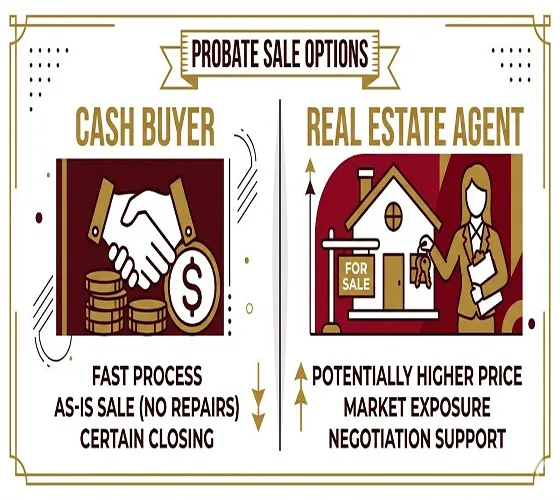
For most California probate sales, a cash buyer closes faster and with less risk of deal collapse — but a traditional agent listing may yield a higher gross price if the estate has time and the property is in marketable condition.
Cash buyers close in 7–14 days from an accepted offer; traditional listings take 60–90 days after finding a buyer, plus an additional 2–3 months if court confirmation is required. Probate properties frequently fail conventional buyer financing due to condition issues or title complexity — a cash buyer eliminates that risk entirely.
| ℹ️ What Is a Probate Sale? A probate sale is the court-supervised sale of real property belonging to a deceased person’s estate. In California, the personal representative must be officially appointed and receive Letters Testamentary or Letters of Administration before acting on the estate’s behalf, and whether the sale needs court confirmation depends on whether the representative has full or limited authority under the Independent Administration of Estates Act (IAEA). |
lightbulbKey Takeaways
check_circle
California probate typically takes 12-18 months from petition to close, but the property sale itself can close in 7–14 days once the executor has legal authority.
check_circle
Buyer financing is a common reason some home sales fall through, though the exact rate varies by market and source.
check_circle
A cash buyer purchases as-is — no repairs, no cleaning, no staging — and covers all closing costs.
check_circle
Traditional agent commission runs 5–6% of the sale price; a direct cash buyer charges no fees or commissions.
check_circle
A decision tree near the end of this article identifies which option fits your estate in under 60 seconds.
When a California executor finally receives Letters Testamentary, the question usually isn’t “should I sell?” — it’s “how fast can this be done, and at what cost?”
Most inherited California properties come with complications a standard listing doesn’t account for: out-of-state executors who can’t manage showings, deferred maintenance that triggers financing objections, and a court confirmation process that can add months to an already extended timeline.
This post gives a concrete, numeric comparison of both routes — and a decision tree that identifies the right option for your specific situation in under 60 seconds.
Disclaimer: This article provides general information about California probate real estate options. It is not legal advice. Consult a California probate attorney for guidance specific to your estate.
A standard agent listing assumes a property in marketable condition, a seller who is available to manage showings, and a buyer using conventional financing. Inherited California properties often fall short on all three.
Most buyers using conventional lender financing require the property to meet minimum condition standards before the lender will approve the loan.
An inherited home with hoarder accumulation, deferred maintenance, or fire and water damage will fail a standard lender appraisal, causing the deal to collapse after weeks of waiting. The executor then faces a difficult choice: fund repairs out of the estate before any sale proceeds arrive, or accept a lower price from the much smaller pool of cash buyers willing to bid at a traditional listing.
Even properties in reasonable structural condition often need cleaning and decluttering before any agent will list them. For a property full of a deceased parent’s belongings, that process takes time, money, and emotional energy the estate may not have.
If the executor does not hold full IAEA authority, California law requires court confirmation of the sale — regardless of whether the buyer is paying cash or using a mortgage. Court confirmation adds a minimum of 2–3 months to the timeline. It also introduces overbidding risk: any member of the public can appear at the confirmation hearing and outbid the accepted offer, reopening the sale process entirely.
Executors with full IAEA authority can usually sell probate property without court confirmation and close directly. However, some estates receive only limited authority, or are not eligible for full IAEA authority at all, depending on the will and the court’s order.
A direct cash buyer purchases the property as-is — no repairs, no lender, and no court-confirmation delay beyond what California law already requires for the specific estate.
Osborne Homes has purchased inherited and probate properties across California since 2007, including homes with hoarding situations, structural damage, and deferred maintenance. They are a principal buyer, not a lead aggregator — meaning one party, one offer, one close.
The process works like this: the executor contacts Osborne, a local representative, schedules a walkthrough (typically within 48–72 hours), and a written cash offer is presented. There is no financing contingency, so there is no risk of the deal falling through after weeks of negotiation. Once the executor has confirmed legal authority, the sale can close in as few as 7–14 days.
The right choice depends on how the estate weighs speed, net proceeds, and the probability of the deal closing without complications.
| Factor | Cash Buyer (Osborne Homes) | Traditional Agent Listing |
|---|---|---|
| Time to close | 7–14 days from accepted offer | 60–120+ days after finding a buyer, plus court confirmation if required |
| Property condition required | Any condition — as-is, no repairs or cleaning | Market-ready preferred; lender may require repairs before financing is approved |
| Agent commission | None | 5–6% of sale price |
| Closing costs | Covered by Osborne Homes | Typically 1–3% paid by estate |
| Court confirmation | Not required if executor has IAEA authority | May be required depending on IAEA authority |
| Overbidding risk | None | Court confirmation opens the sale to public overbidding |
A traditional listing often produces a higher gross sale price — but gross and net are not the same number, and for a probate property, the gap is wider than most executors expect.
Consider an inherited property with a fair market value of $420,000:
Now compare that to a cash offer of $380,000 with zero commissions, zero seller fees, and the buyer covering all closing costs. The estate receives $380,000 — roughly $8,600 more than the traditional listing net, while closing in weeks rather than months.
Probate attorney fees continue to accrue for every month the listing process takes, further narrowing the advantage of the higher gross price. A months-long listing adds cost at exactly the point when the estate is trying to close.
Overbidding in a court confirmation hearing can increase the final price — but it adds unpredictability and timeline exposure that an estate with urgent needs may not be in a position to absorb.
👉 Want to calculate your closing costs? Use our California Closing Cost Calculator.
Answer these four questions to identify the lower-risk route for your estate.
Is the property in a condition a conventional buyer’s lender would finance? NO → A cash buyer is your fastest and most certain option. YES →
Do you need to close in under 60 days? YES → Cash buyer. NO →
Does the estate have the budget for repairs, cleaning, and staging before listing? NO → Cash buyer. YES →
Are all heirs in agreement on the listing price and timeline? NO → A cash buyer eliminates the ongoing negotiation friction between parties. YES → A traditional listing may produce a higher gross price if the property is in good condition and the estate has time.
Generally no. The executor must hold Letters Testamentary or Letters of Administration before a legally binding sale can close. Obtaining those letters typically takes several months from the initial probate petition filing.
If the executor holds full IAEA authority, court confirmation is not required — regardless of whether the buyer pays cash or uses financing. Without IAEA authority, all sales require court confirmation. Whether an estate qualifies for full IAEA authority depends on the terms of the will or the court order.
All heirs and beneficiaries with an interest in the estate must typically be notified of any proposed sale. A formal objection may trigger court confirmation, which opens the sale to overbidding. Consult a California probate attorney before accepting any offer if there is disagreement among heirs.
The full California probate process takes 12-18 months on average. However, the property sale itself is a distinct event — once the executor has confirmed legal authority, a cash buyer can close in 7–14 days. The broader probate administration continues after the property sale closes.
No. Osborne Homes pays all closing costs and charges no commissions or fees. The cash offer presented is the net amount the estate receives. Osborne Homes is a real estate investment company, not a real estate agent.
Yes. Osborne buys as-is — no cleaning, repairs, or staging required. This includes inherited homes with hoarding accumulation, structural issues, and fire or water damage that would disqualify the property from conventional buyer financing.
For most California probate estates — particularly those involving a property in less-than-perfect condition, an out-of-state executor, or a need to close on a defined timeline — a direct cash buyer eliminates more risk than a traditional listing introduces. The net price difference is often narrower than executors expect once commissions, pre-sale costs, and time are factored in.
For more on managing an inherited property in California, see our guide to selling an inherited house in California — or get a no-obligation cash offer from Osborne Homes for your specific property.
General information only — not legal advice. Consult a California probate attorney for your specific estate.

The Osborne Homes Team
The Osborne Homes team specializes in California real estate, helping buyers, sellers, and homeowners navigate the market with clarity and confidence. Our articles are written to provide practical guidance, local insight, and up-to-date information you can trust.



Get a no-obligation cash offer in as little as 48 hours. No repairs, no agents, no stress. Just a dignified way to move forward.
Free property assessment. No obligation. No pressure.
sell