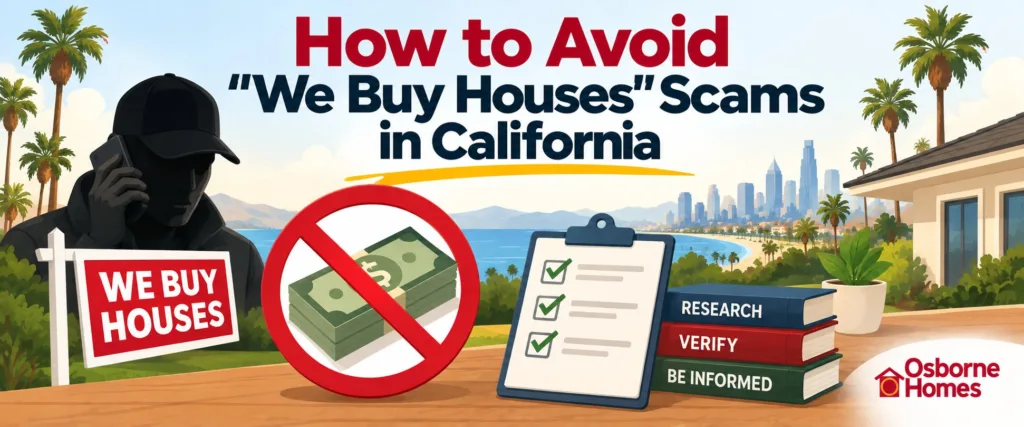
FAST ANSWER: You can avoid “we buy houses” scams in California by walking away from any buyer who asks you for money up front, pushes you to sign the same day, makes an offer without seeing the house, or cuts the price after you’ve committed. Legitimate cash home buyers put the offer in writing, prove their funds, and close through an independent escrow or title company. Handled that way, a direct cash sale can close in as few as 7 days.
If a postcard, a text, or a yard sign offering cash for your house made you wonder whether it’s a scam, that instinct is worth listening to. Avoiding “we buy houses” scams starts with accepting that both kinds of buyers use the same signs. Some are well-funded real estate investment companies that close exactly as promised. Others rely on the speed of a cash sale to hurry sellers past the details that protect them.
California’s home values make owners here a target. In a November 2025 consumer alert, the California Department of Real Estate listed deed fraud, equity skimming, and elder financial exploitation among the most common real estate crimes it sees. The checklist below works on any cash home buyer, whoever they are. It covers the red flags, the questions to ask, how to verify the answers, and where to turn in California if something goes wrong.
lightbulbKey Takeaways
check_circle
Legitimate California cash buyers never charge sellers upfront fees, so any request for money from you is a red flag.
check_circle
Pressure to sign immediately is the most common scam tactic; a real buyer gives you time to review.
check_circle
A last-minute price drop after a no-look offer is a classic bait-and-switch.
check_circle
Never sign over your deed or title to anyone before the sale closes through a licensed escrow or title company.
check_circle
Ask for proof of funds and references, check reviews and business registration, and get a written, itemized offer before you sign.
check_circle
Real estate fraud is rising: the FBI’s Internet Crime Complaint Center logged 12,368 real estate fraud complaints and more than $275 million in losses in 2025.
The clearest scam signals are upfront fees, high-pressure timelines, no-look offers, and last-minute price cuts. Two more belong on the list because they tend to cost sellers the most: requests to hand over your title, and contracts the buyer never intends to close.
Wholesaling is legal in California, and not every wholesaler acts in bad faith. The risk is practical. The wholesaler’s assignment fee comes out of your price, and if no end buyer turns up, the deal can fall apart weeks later.
Unsolicited texts and mailers aren’t proof of a scam on their own. Investors pull owner names from public property records, which is why your phone lights up. Treat them as a reason to vet the sender more carefully.
Vet a cash buyer with six direct questions about funds, track record, fees, references, timeline, and how they price. A good answer is specific and comes in writing. An evasive one sounds like reassurance with nothing underneath.
| Question | A good answer sounds like | An evasive answer sounds like |
| Can you show proof of funds, and will you close in your own name? | A recent bank statement or letter in the name of the company signing the contract. | “We have investors lined up,” or a letter from a third-party funder. |
| How long have you been buying homes in California, and how many? | A founding year, a transaction count, and a local office address. | “Years,” “lots,” and no fixed address. |
| Are there fees or costs taken out of my offer? | An itemized list showing who pays escrow, title, and transfer costs. | “We’ll sort that out at closing.” |
| Can I talk to sellers you’ve bought from? | Names you can call, plus reviews on sites the buyer doesn’t control. | Only testimonials on their own website. |
| What’s the closing date, and how long is the inspection period? | A fixed closing date and a short inspection window of about a week. | An open-ended contingency of two weeks or more. |
| How did you arrive at this price? | Comparable sales and a repair estimate, shown to you. | “That’s our formula,” or an unexplained number well above other offers. |
An offer far above what other cash buyers quote isn’t automatically good news. If the buyer can’t show the comparable sales and repair figures behind it, a high opening number is often the setup for a price cut later in escrow.
Verify a cash buyer by checking proof of funds, business registration, independent reviews, and a written offer. None of these steps asks you to take the buyer’s word for anything, and most take a few minutes.
Osborne Homes, a California real estate investment company that has bought houses directly for cash since 2007, works to the same standard: written offers, and Osborne Homes reviews you can check against our BBB and Google profiles.
Here is how scam behavior compares with how a legitimate California cash buyer operates.
| Scam signal | Legitimate buyer | |
| Fees | Asks you for an application, processing, or holding fee | Charges the seller nothing; costs are settled in escrow |
| Offer format | Verbal or vague, with blanks to “fill in later” | Written and itemized, with price, deposit, and closing date |
| Timeline pressure | “Sign today or the offer’s gone” | Gives you time to review and get advice |
| Property visit | Prices the house without seeing it | Walks the property before making a firm offer |
| References | None, or only on its own website | Verifiable reviews, BBB profile, past sellers you can call |
| Price stability | Drops the price after you’ve committed | Closes at the agreed price unless an undisclosed defect turns up |
| Title and closing | Wants the deed signed over, or its own “closing agent” | Closes through an independent escrow or title company |
In short, a legitimate cash buyer charges you no fees, puts the offer in writing, sees the house before firming up a price, and closes at that price through a neutral escrow company. A buyer who fails any one of those tests deserves a harder look.
California homeowners have a few legal protections beyond general caution, and several agencies take complaints about suspect buyers.
If your home is in foreclosure, meaning a notice of default has been recorded, California’s Home Equity Sales Contract Act covers most sales to investors. You can cancel the contract in writing until midnight of the fifth business day after you sign, or until 8 a.m. on the day of the scheduled foreclosure sale if that comes first.
Deed alerts help you catch title fraud early. Los Angeles County runs a free Homeowner Notification Program, and Orange County offers a Real Estate Fraud Alert. Under SB 255, every other California county must offer recorder notifications by January 1, 2027.
If something goes wrong, report real estate crimes and licensee misconduct to the California DRE, and scams to the California Attorney General. Online or wire fraud goes to the FBI at ic3.gov.
Many are. Real estate investment companies buy California homes for cash every day, and the business model is legal. The trouble is that wholesalers and scammers use the same signs and mailers. A buyer earns trust by proving funds, putting the offer in writing, charging you no fees, and closing through an independent escrow company. To see how direct cash buyers differ from iBuyers, compare Osborne vs iBuyers.
A cash home buyer is probably a scam if they ask you for money, push you to sign immediately, want your deed before closing, or won’t show proof of funds. Other warning signs include offers made without seeing the house, fuzzy answers about fees, and a price that drops once you’ve signed. Checking BBB complaints and the Secretary of State business record takes only a few minutes.
No. A legitimate cash buyer never asks a seller for an application, processing, or holding fee. The buyer covers its own inspection and due-diligence costs. Any closing costs you owe are settled through escrow at closing, never paid to the buyer beforehand. The California DRE gives the same warning about foreclosure “help”: real programs don’t charge upfront fees.
Ask for a bank statement or bank letter dated within about a week, in the exact name of the person or company signing your purchase contract. Then call the bank on a number you find yourself, not one printed on the letter, and confirm the document is genuine. A letter from a third-party “transactional funder” suggests the buyer may plan to assign your contract.
A legitimate written cash offer states the purchase price, the buyer’s legal name, the earnest money deposit, the inspection period, the closing date, the escrow or title company, and who pays each closing cost. It has no financing contingency and no fees charged to you. Read any assignment clause closely, and ask in writing whether the price can change after inspection.
If speed and certainty matter more than squeezing out the last dollar, a direct cash sale is worth weighing against the traditional route. Whoever you talk to, don’t sign or pay anything until the funds are verified and a neutral escrow company holds the deal. If you’d like an offer to test against this checklist, Osborne Homes makes no-obligation written cash offers and can close in as few as 7 days.

The Osborne Homes Team
The Osborne Homes team specializes in California real estate, helping buyers, sellers, and homeowners navigate the market with clarity and confidence. Our articles are written to provide practical guidance, local insight, and up-to-date information you can trust.
Get a no-obligation cash offer in as little as 48 hours. No repairs, no agents, no stress. Just a dignified way to move forward.
Free property assessment. No obligation. No pressure.
sell