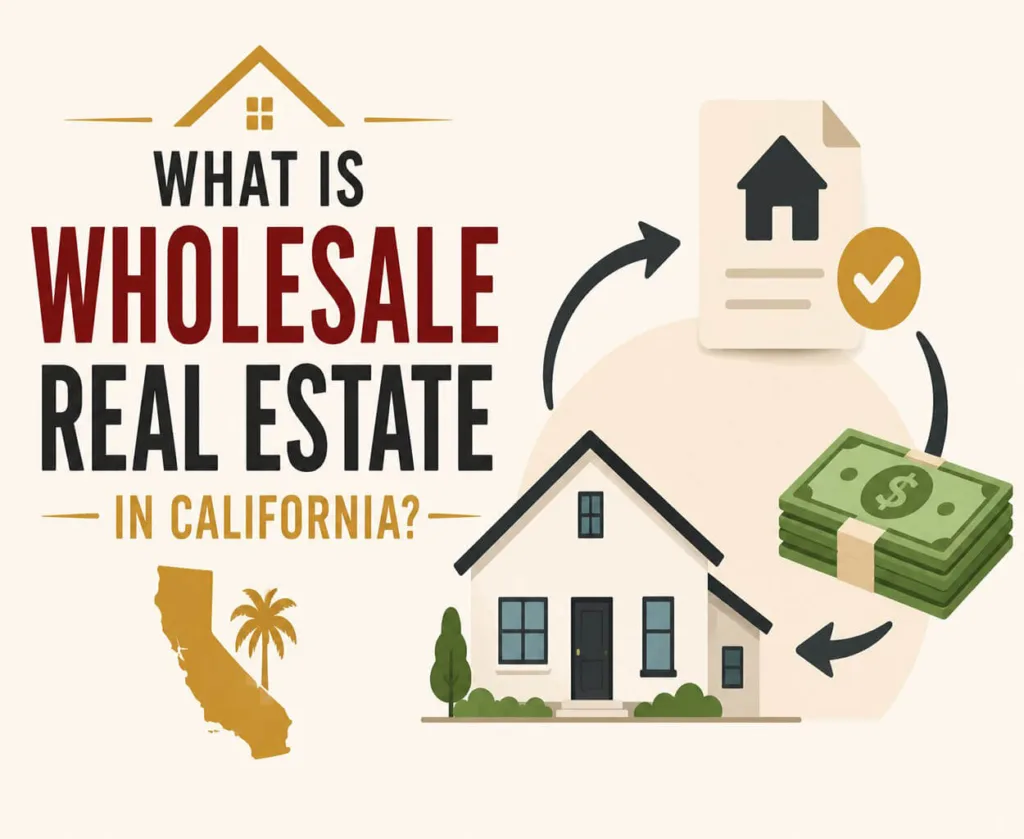
In wholesale real estate, an investor contracts a property below market value, then assigns that contract to a third-party buyer for a fee — without ever purchasing the property themselves. From a seller’s perspective, this means you are not dealing with the actual buyer. You are dealing with a middleman who profits from the spread between your price and what they sell the contract for.
If you’ve received an offer from someone and aren’t sure whether they’re a wholesaler or a direct buyer, this page explains the difference — and why it matters for how certain your sale actually is.
lightbulbKey Takeaways
check_circle
A wholesaler is a middleman, not the buyer. They contract your property, then sell that contract to a third party for a fee. You never interact with the person who actually purchases your home.
check_circle
Deal certainty is lower with a wholesaler. If they can’t find an end buyer, your sale can fall through – sometimes close to your planned closing date.
check_circle
Legality depends on structure. Wholesale real estate can be lawful in California when handled correctly, but unlicensed brokerage activity and misleading marketing create real compliance risks.
check_circle
A direct buyer eliminates the middleman. The company making the offer is the company buying the property – no assignment, no unknown third party.
check_circle
Always ask before signing. “Are you the end buyer, or will this contract be assigned to another investor?” A direct buyer will confirm in writing.
Wholesale real estate is a transaction structure in which an investor places a property under contract, then assigns the right to purchase that property to a third-party buyer for an assignment fee. The wholesaler never takes ownership of the home. They profit from the difference between the contracted price and what the end buyer pays.
The profit – called the assignment fee – is the difference between what you agreed to sell for and what the wholesaler’s end buyer pays. For example, a wholesaler contracts your property at $200,000 and assigns it to an investor for $215,000. Their profit is $15,000. You receive $200,000. You never interact with the person who actually purchases your home.
Wholesale real estate can be lawful in California when a person is assigning their own contract and not engaging in unlicensed brokerage activity, but the structure, disclosures, and marketing must be handled carefully.
Disclosure of the intent to assign is one requirement, but it doesn’t resolve every legal risk. Misrepresenting the transaction, acting in a way that resembles a licensed agent, or advertising in a misleading way can all create compliance problems under California law and DRE regulations.
Distressed properties facing foreclosure, probate, needed repairs, or divorce settlement deadlines are common wholesale targets because motivated sellers often prioritize speed over maximum price. That is not inherently wrong, but it is important to understand who you’re actually dealing with.
| Type | Who they are |
Who actually buys your home |
Their profit source |
Deal certainty for seller |
|---|---|---|---|---|
| Wholesaler | An intermediary | A third-party investor (often unknown to you) | Assignment fee – the spread between your price and theirs | Low – deal can collapse if they can’t assign the contract |
| Direct cash buyer (Osborne Homes) | Principal investor | The company you’re negotiating with directly | Renovation and resale margin | High – no middleman, no assignment risk |
| iBuyer | Tech-platform direct buyer | The platform itself | Service fee plus resale margin | High in most cases |
The critical difference for sellers is deal certainty. A wholesaler’s offer depends on their ability to find a third-party buyer willing to pay enough to cover your price plus their fee. If they can’t find that buyer, your deal can fall through, sometimes close to the date you planned to close.
No.
Osborne Homes is a direct cash buyer, a principal investor that purchases California properties using its own capital. We do not assign contracts to third parties or act as an intermediary. When you accept an offer from Osborne Homes, Osborne Homes is the buyer.
Our business model is to purchase properties using our own capital, renovate, and resell. That means no assignment fees, no unknown end buyers, and no dependence on finding a third party to complete the transaction. Osborne Homes has operated this way in California since 2007 and has purchased over 5,000 properties.
If you want to verify this for any offer you receive – from us or anyone else – ask directly: “Are you the end buyer, or will this contract be assigned to another investor?” A direct buyer will confirm in writing that they are the purchasing entity.
| Factor | Wholesale buyer | Osborne Homes (direct) |
|---|---|---|
| Who actually buys your home | Unknown third-party investor | Osborne Homes |
| Deal certainty | Low – depends on finding an assignee | High – Osborne is the buyer |
| How to verify | Ask: “Are you assigning this contract or buying directly?” | Written confirmation that Osborne is the purchasing entity |
| Offer basis | Your price reflects the wholesaler’s margin | Offer based on actual market value in current condition |
| Time to close | Variable | 7–14 days |
| Fees to seller | None upfront – but your price reflects the middleman margin | Zero fees, zero commission |
Wholesalers actively search for motivated sellers. Homeowners in foreclosure, dealing with probate, going through divorce, or sitting on a property that needs significant repairs. They target situations where urgency may lead a seller to accept a lower price quickly.
There’s nothing inherently deceptive about this. But it means if you’re in a distressed situation and have received an unsolicited offer, there’s a reasonable chance it’s from a wholesaler rather than a direct buyer. Understanding what you’re agreeing to – and who you’re actually selling to – is worth a few minutes before you sign anything.
For a straight comparison of what the cash sale process looks like with a direct buyer, see the California cash home sale closing process.
To understand how to spot offers that may not be what they appear, see how to avoid we buy houses scams.
And if you’re ready to sell without uncertainty, Osborne Homes can help. Contact us to get your no-obligation cash offer.
A wholesaler contracts a property below market value, then assigns that contract to a third-party investor for a fee, without ever owning the property. The seller deals with the wholesaler – not the actual end buyer – throughout the transaction.
It can be, when structured correctly. Assigning your own purchase contract is not automatically prohibited, but California law and DRE regulations mean the legality depends on how the deal is structured, disclosed, and marketed. Acting in a way that resembles unlicensed brokerage activity is the primary compliance risk. Anyone operating as a wholesaler in California should consult a real estate attorney to confirm their specific approach is sound.
Ask directly: “Are you the end buyer, or will this contract be assigned to another investor?” A direct buyer like Osborne Homes purchases using its own capital. There is no assignment. Request written confirmation of who the purchasing entity is before signing anything.
A direct buyer provides more certainty. The deal cannot collapse because of a failed assignment. For sellers with a time constraint or a distressed property, that certainty typically matters more than minor price differences between offers.
No. Osborne Homes is a direct buyer. We purchase California properties using our own capital and never assign contracts to third parties. When Osborne makes an offer, Osborne is the buyer.

The Osborne Homes Team
The Osborne Homes team specializes in California real estate, helping buyers, sellers, and homeowners navigate the market with clarity and confidence. Our articles are written to provide practical guidance, local insight, and up-to-date information you can trust.


Get a no-obligation cash offer in as little as 48 hours. No repairs, no agents, no stress. Just a dignified way to move forward.
Free property assessment. No obligation. No pressure.
sell
In wholesale real estate, an investor contracts a property below market value, then assigns that contract to a third-party buyer for a fee — without ever purchasing the property themselves. From a seller’s perspective, this means you are not dealing with the actual buyer. You are dealing with a middleman who profits from the spread between your price and what they sell the contract for.
If you’ve received an offer from someone and aren’t sure whether they’re a wholesaler or a direct buyer, this page explains the difference — and why it matters for how certain your sale actually is.
Wholesale real estate is a transaction structure in which an investor places a property under contract, then assigns the right to purchase that property to a third-party buyer for an assignment fee. The wholesaler never takes ownership of the home. They profit from the difference between the contracted price and what the end buyer pays.
The profit – called the assignment fee – is the difference between what you agreed to sell for and what the wholesaler’s end buyer pays. For example, a wholesaler contracts your property at $200,000 and assigns it to an investor for $215,000. Their profit is $15,000. You receive $200,000. You never interact with the person who actually purchases your home.
Wholesale real estate can be lawful in California when a person is assigning their own contract and not engaging in unlicensed brokerage activity, but the structure, disclosures, and marketing must be handled carefully.
Disclosure of the intent to assign is one requirement, but it doesn’t resolve every legal risk. Misrepresenting the transaction, acting in a way that resembles a licensed agent, or advertising in a misleading way can all create compliance problems under California law and DRE regulations.
Distressed properties facing foreclosure, probate, needed repairs, or divorce settlement deadlines are common wholesale targets because motivated sellers often prioritize speed over maximum price. That is not inherently wrong, but it is important to understand who you’re actually dealing with.
| Type | Who they are | Who actually buys your home | Their profit source | Deal certainty for seller |
|---|---|---|---|---|
| Wholesaler | An intermediary | A third-party investor (often unknown to you) | Assignment fee – the spread between your price and theirs | Low – deal can collapse if they can’t assign the contract |
| Direct cash buyer (Osborne Homes) | Principal investor | The company you’re negotiating with directly | Renovation and resale margin | High – no middleman, no assignment risk |
| iBuyer | Tech-platform direct buyer | The platform itself | Service fee plus resale margin | High in most cases |
The critical difference for sellers is deal certainty. A wholesaler’s offer depends on their ability to find a third-party buyer willing to pay enough to cover your price plus their fee. If they can’t find that buyer, your deal can fall through, sometimes close to the date you planned to close.
No.
Osborne Homes is a direct cash buyer, a principal investor that purchases California properties using its own capital. We do not assign contracts to third parties or act as an intermediary. When you accept an offer from Osborne Homes, Osborne Homes is the buyer.
Our business model is to purchase properties using our own capital, renovate, and resell. That means no assignment fees, no unknown end buyers, and no dependence on finding a third party to complete the transaction. Osborne Homes has operated this way in California since 2007 and has purchased over 5,000 properties.
If you want to verify this for any offer you receive – from us or anyone else – ask directly: “Are you the end buyer, or will this contract be assigned to another investor?” A direct buyer will confirm in writing that they are the purchasing entity.
| Factor | Wholesale buyer | Osborne Homes (direct) |
|---|---|---|
| Who actually buys your home | Unknown third-party investor | Osborne Homes |
| Deal certainty | Low – depends on finding an assignee | High – Osborne is the buyer |
| How to verify | Ask: “Are you assigning this contract or buying directly?” | Written confirmation that Osborne is the purchasing entity |
| Offer basis | Your price reflects the wholesaler’s margin | Offer based on actual market value in current condition |
| Time to close | Variable | 7–14 days |
| Fees to seller | None upfront – but your price reflects the middleman margin | Zero fees, zero commission |
Wholesalers actively search for motivated sellers. Homeowners in foreclosure, dealing with probate, going through divorce, or sitting on a property that needs significant repairs. They target situations where urgency may lead a seller to accept a lower price quickly.
There’s nothing inherently deceptive about this. But it means if you’re in a distressed situation and have received an unsolicited offer, there’s a reasonable chance it’s from a wholesaler rather than a direct buyer. Understanding what you’re agreeing to – and who you’re actually selling to – is worth a few minutes before you sign anything.
For a straight comparison of what the cash sale process looks like with a direct buyer, see the California cash home sale closing process.
To understand how to spot offers that may not be what they appear, see how to avoid we buy houses scams.
And if you’re ready to sell without uncertainty, Osborne Homes can help. Contact us to get your no-obligation cash offer.
A wholesaler contracts a property below market value, then assigns that contract to a third-party investor for a fee, without ever owning the property. The seller deals with the wholesaler – not the actual end buyer – throughout the transaction.
It can be, when structured correctly. Assigning your own purchase contract is not automatically prohibited, but California law and DRE regulations mean the legality depends on how the deal is structured, disclosed, and marketed. Acting in a way that resembles unlicensed brokerage activity is the primary compliance risk. Anyone operating as a wholesaler in California should consult a real estate attorney to confirm their specific approach is sound.
Ask directly: “Are you the end buyer, or will this contract be assigned to another investor?” A direct buyer like Osborne Homes purchases using its own capital. There is no assignment. Request written confirmation of who the purchasing entity is before signing anything.
A direct buyer provides more certainty. The deal cannot collapse because of a failed assignment. For sellers with a time constraint or a distressed property, that certainty typically matters more than minor price differences between offers.
No. Osborne Homes is a direct buyer. We purchase California properties using our own capital and never assign contracts to third parties. When Osborne makes an offer, Osborne is the buyer.