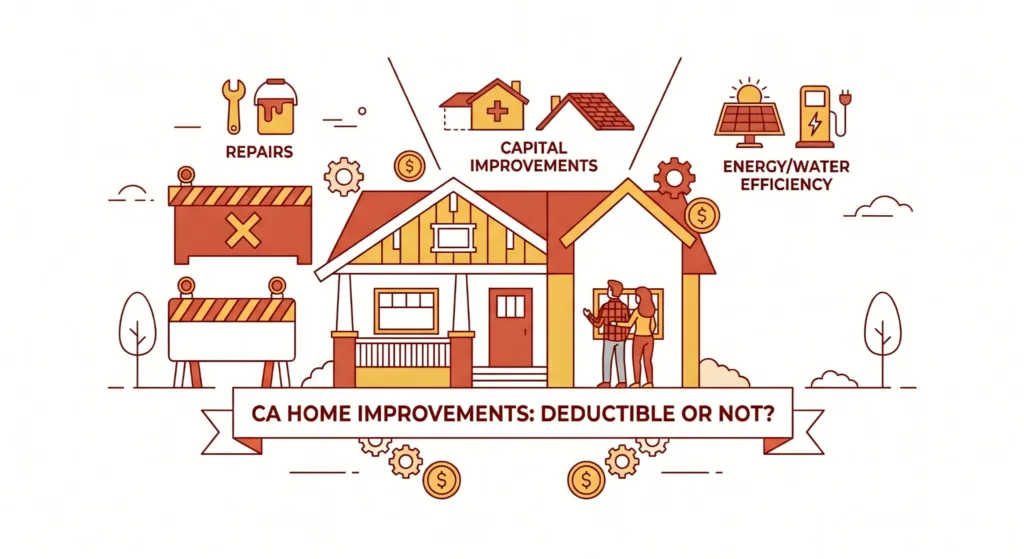
Most home improvements are not currently deductible for a primary residence in California. Instead, projects that qualify as capital improvements, such as a new roof, kitchen remodel, or HVAC replacement, may be added to your home’s cost basis, reducing the capital gains you owe when you sell.
Some exceptions apply: some energy-efficiency upgrades may qualify for federal tax credits, medical necessity improvements may be deductible, and rental property repairs are deductible as operating expenses in the year incurred.
This guide breaks down exactly which improvements qualify, how to claim them, and the critical distinction between capital improvements and repairs that most homeowners get wrong.
lightbulbKey Takeaways
check_circle
Most home improvements are not currently deductible for a primary residence in California – they may reduce capital gains at sale by increasing your cost basis instead.
check_circle
The capital improvements vs. repairs distinction is the most important tax concept for homeowners – repairs are not added to basis; qualifying improvements are.
check_circle
Some energy-efficient improvements may qualify for federal tax credits – but eligibility depends on the tax year, the specific property, and current IRS rules. Review the latest IRS instructions for the year you file before assuming any credit applies.
check_circle
Rental property follows different rules – repairs are immediately deductible, capital improvements must be depreciated over 27.5 years, and accumulated depreciation is recaptured at sale at a maximum 25% federal rate.
check_circle
The Section 121 exclusion ($250,000 single/$500,000 married) applies on top of cost basis – California homeowners with a high basis and long hold period often owe little or no capital gains.
check_circle
California has no state-specific energy credit – federal credits only. For principal residence sales, California conforms to the federal Section 121 exclusion. For rental properties, consult a tax professional on the specific California treatment of your gain.
check_circle
Selling as-is eliminates renovation risk – the cost basis benefit accrues whether you improve before selling or not, but upfront repair costs are unrecoverable if the market doesn’t reward them.
This is the most important distinction in home improvement taxation, and it’s the one most homeowners miss.
The IRS defines a capital improvement as any project that adds value to your home, prolongs its useful life, or adapts it to a new use. A repair merely restores the property to its original working condition. They are taxed completely differently.
| Category | Tax Treatment | Examples |
|---|---|---|
| Capital improvements | May be added to cost basis; can reduce capital gains at sale | New roof, kitchen remodel, room addition, HVAC replacement, foundation repair, new windows |
| Repairs and maintenance | Not added to basis; not deductible for primary residence | Fixing a leak, patching drywall, repainting, replacing a broken appliance |
| Energy efficiency upgrades | Some may qualify for federal tax credits (IRS Form 5695); may also add to basis | Solar panels, heat pumps, insulation, qualifying energy-efficient windows, EV charger |
| Rental property repairs | Deductible as operating expense in the year incurred | Any repair on an actively rented property |
| Medical necessity improvements | May be deductible as medical expense if total medical expenses exceed 7.5% AGI threshold | Wheelchair ramps, accessible shower, stair lift |
The IRS distinguishes improvements from repairs based on whether the work adds value, prolongs useful life, or adapts the property to a new use. When in doubt, consult a tax professional – the distinction is frequently contested in audits.
Home improvements fall into two broad categories from a tax standpoint: repairs and improvements.
Repairs are maintenance. They restore existing condition and are not deductible for primary residences.
Improvements may increase value or extend useful life, and while they’re generally not currently deductible for a primary residence, qualifying capital improvements can reduce your tax bill when you eventually sell by increasing your cost basis.
Here are the situations where home improvements may qualify for immediate deductions or credits:
If you or someone in your household needs home modifications for medical reasons – wheelchair ramps, widening doorways, an accessible shower, stair lifts – these costs may be deductible as medical expenses.
Only the amount that exceeds any increase in your home’s market value can be claimed, and the total medical expense must exceed 7.5% of your adjusted gross income (AGI) to be deductible.
See the IRS Medical and Dental Expenses Guide for full qualification rules.
Some energy-efficient improvements may qualify for federal tax credits, but eligibility depends on the tax year, the specific property, and current IRS rules. Because IRS guidance can change, review the latest instructions for the year you file before assuming any credit applies.
Any qualifying improvements that do not generate a tax credit may still add to your home’s cost basis as capital improvements, reducing capital gains at sale.
California has no state-specific energy efficiency credit separate from the federal program, but the California Solar Initiative and SGIP battery storage rebates may provide additional financial incentives independent of federal tax treatment.
If you have a dedicated home office used exclusively and regularly for business, improvements to that specific space may be treated differently from the rest of the home, but the rules are more limited than many homeowners assume.
Home office expenses may be deductible only to the extent allowed under the IRS business-use-of-home rules. For improvements entirely within the exclusive-use office space, the deductible portion depends on whether the work is a repair or a capital improvement. Repairs may be deductible for the business-use percentage; capital improvements are generally depreciated rather than immediately deducted. Improvements that benefit the whole home are not fully deductible as home office expenses – at most, a proportional business-use percentage may be allocable.
The home office deduction also allows you to deduct a proportional share of certain ongoing costs (utilities, insurance, property taxes) based on the percentage of your home used for business, but this is separate from home improvement costs.
The home office rules are nuanced and frequently audited. See the IRS home office deduction guidelines and consult a tax professional before claiming any improvement costs as business expenses.
| Type | What Qualifies |
|---|---|
| Medical-related upgrades | Wheelchair ramps, handrails, accessibility features – deductible portion above any home value increase, subject to 7.5% AGI threshold |
| Energy-efficient improvements | Some solar panels, heat pumps, insulation, and qualifying windows – check IRS Form 5695 eligibility for each specific upgrade |
| Home office improvements | Direct improvements to the exclusive-use office space only – not whole-home improvements proportionally allocated |
| LED lighting upgrades | Energy-saving LED installations – may qualify for federal energy tax credits depending on product certification; check current IRS Form 5695 instructions |
| Water conservation | Low-flow faucets, toilets, and irrigation systems – may add to cost basis as capital improvement |
| Landscaping for efficiency | Drought-resistant vegetation, shade trees – may qualify as capital improvement if they add value or reduce operating costs |
Every time you make an improvement – a new roof, kitchen remodel, HVAC replacement, new windows – keep all receipts, contractor invoices, and permits. These records substantiate your cost basis when you sell, and you’ll need them to calculate your taxable gain accurately.
Capital improvements don’t reduce your taxes today. They reduce your taxes when you sell. If you bought your home for $300,000 and spent $50,000 on qualifying improvements, your cost basis becomes $350,000. When you sell, your taxable gain is calculated against that higher basis, not your original purchase price.
Example: You sell for $700,000. Without improvements tracked: gain of $400,000. With $50,000 in documented improvements: gain of $350,000. On a home held for many years in California’s appreciating market, that difference can mean tens of thousands in tax savings.
The Section 121 exclusion ($250,000 for single filers, $500,000 for married couples filing jointly) still applies on top of any basis increase, so California homeowners with a high basis and a long hold period can often sell with minimal or zero capital gains exposure.
Some energy credits reduce your tax bill dollar-for-dollar rather than simply reducing taxable income. Eligibility depends on the tax year and the specific property installed. Review the current IRS Form 5695 instructions for the year you file before claiming any credit. Unlike deductions, credits are not affected by your tax bracket.
Rental property owners operate under a separate set of rules that the primary-residence framework doesn’t cover.
Repairs on rental property are immediately deductible. A broken water heater, roof patch, or repainting between tenants is deducted as an operating expense in the year it’s incurred – no basis adjustment required.
Capital improvements must be depreciated over 27.5 years. A new roof, kitchen renovation, or HVAC replacement on a rental is not immediately deductible. Instead, the cost is depreciated over the IRS’s 27.5-year residential property schedule, roughly 3.6% of the improvement cost per year.
Depreciation recapture applies at the sale. When you sell a rental property, all accumulated depreciation must be recaptured.
Under federal rules, depreciation recapture is taxed at a maximum 25% rate. This is separate from the capital gain on the property’s appreciation, which is taxed at the applicable long-term capital gains rate. The two components are calculated and taxed differently, which is why rental property sales often generate a higher combined tax bill than sellers expect.
The California tax treatment of rental property gains and depreciation recapture can vary by situation. Consult a tax professional with California rental experience before selling.
For rental property owners considering selling, understanding your depreciation recapture liability before accepting any offer is essential.
👉 See our California Capital Gains Tax on Rental Property guide for a full walkthrough of how recapture is calculated.
This is one of the most common questions California homeowners face, and the math often doesn’t favor spending on improvements before listing.
Cost vs. return: A $20,000 kitchen remodel might increase your sale price by $15,000 in a slow market. The renovation doesn’t always recoup its cost, especially in markets where buyers expect to customize anyway.
Time and stress: Finding contractors, managing timelines, and living through a renovation adds months to a process many sellers want to complete quickly. If you’re already under financial pressure, that timeline can be costly.
Selling as-is: The cost basis benefit of improvements accrues whether you make improvements and sell traditionally, or whether you sell as-is. For sellers who don’t have capital to invest upfront, the as-is route removes the renovation risk entirely.
👉 For a full comparison of what different repair scenarios mean for your net proceeds, see our Fix or Sell As-Is guide.
Do you have the cash to fund repairs upfront without financial strain?
👉 If you need to calculate the capital gains exposure on your current basis before deciding, use our California Capital Gains Calculator.
Yes, capital improvements (not repairs) are added to your cost basis, directly reducing your taxable capital gains when you sell. Keep all receipts and contractor invoices as documentation. The higher your basis, the lower your gain at sale.
Not immediately on a primary residence. A new roof qualifies as a capital improvement. It gets added to your cost basis and reduces capital gains at sale. On a rental property, a new roof must instead be depreciated over 27.5 years under IRS rules.
Some energy-efficient improvements may qualify for federal tax credits, but eligibility depends on the tax year, the specific property installed, and current IRS rules. Because IRS guidance on energy credits can change, review the latest IRS Form 5695 instructions for the year you file before assuming any credit applies.
Any qualifying capital improvement added to your cost basis reduces your taxable gain at sale. Examples include a new roof, kitchen remodel, HVAC replacement, room additions, new windows, and significant landscaping improvements. Keep records. The IRS requires documentation to substantiate basis claims on your tax return.
For primary residences, California conforms to the federal Section 121 exclusion ($250,000/$500,000) for capital gains on home sales, confirmed by the California FTB. California has no state-specific energy credit. For rental properties, the California tax treatment of gains and depreciation recapture can vary by situation. Consult a tax professional with California rental experience before selling.
If you’re a California homeowner weighing whether to invest in repairs before selling, Osborne Homes offers a direct alternative. We buy homes as-is throughout California – no repairs, no cleaning, no staging.
Our cash offer is based on a transparent, no-obligation property walkthrough. All terms are in writing. There are no last-minute reductions.
Disclaimer: This article is for informational purposes only and does not constitute tax advice. Consult a licensed CPA or tax attorney for guidance specific to your situation and property.

The Osborne Homes Team
The Osborne Homes team specializes in California real estate, helping buyers, sellers, and homeowners navigate the market with clarity and confidence. Our articles are written to provide practical guidance, local insight, and up-to-date information you can trust.



Get a no-obligation cash offer in as little as 48 hours. No repairs, no agents, no stress. Just a dignified way to move forward.
Free property assessment. No obligation. No pressure.
sell