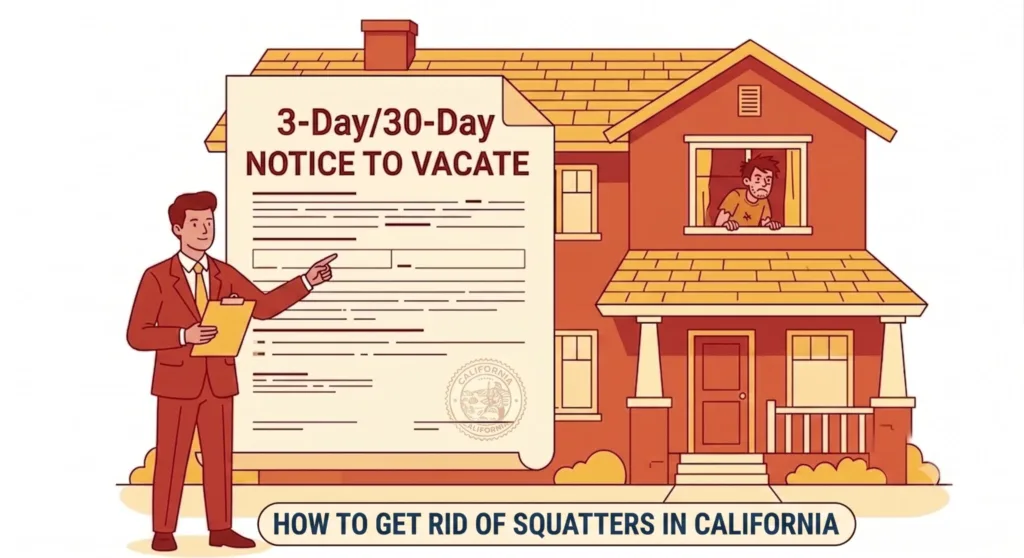
Finding out that someone is living in your property without permission is every homeowner’s nightmare. Even more in California, where the state’s tenant-friendly laws make removing squatters complicated, time-consuming, and emotionally draining.
Now, it doesn’t meant its’ not possible to get rid of squatters in California. It is, but you cannot do it yourself.
California law requires a formal legal process: serve a 3-day notice, file an unlawful detainer lawsuit, and obtain a court order before the sheriff can remove them.
In this guide, we’ll break down how to get rid of squatters in California, explain what rights squatters do (and don’t) have, and walk through your options.
lightbulbKey Takeaways
check_circle
You cannot remove squatters yourself. In California, only law enforcement can physically remove them once a court order is issued.
check_circle
Follow the 5-step legal process: file a police report, serve a three-day notice, file an unlawful detainer lawsuit, attend the court hearing, and contact the sheriff for removal.
check_circle
The standard process can take 30–90 days, depending on court backlogs and whether the squatter contests the eviction.
check_circle
Do not change locks or shut off utilities. These ‘self-help’ actions are illegal and can delay your case.
check_circle
Act quickly to protect your property. Ignoring squatters can complicate the situation or even risk an adverse possession claim.
No, squatting is not legal in California. Living on someone else’s property without permission is considered unlawful, even if the person entered the home without using force. However, California law treats most squatting cases as civil matters, not criminal ones. That means police often can’t remove squatters unless there’s clear evidence of another crime, such as breaking and entering or property damage.
Where things get complicated is when squatters try to claim tenant protections. If they’ve been in the property for an extended period or received mail there, they may be treated as tenants under California’s tenant-friendly eviction laws, requiring formal eviction through the court system.
It’s also important to note that squatters differ from tenants who once had permission to live there. Tenants have signed agreements or leases, while squatters never had any legal right to occupy the property.
Squatters are legally distinct from tenants: tenants had a lawful right to occupy the property at some point; squatters never did.
That distinction matters procedurally, but the practical removal process – notice, lawsuit, court hearing, sheriff – is the same once a squatter asserts any tenancy relationship.
Due process protections that apply to all occupants regardless of legal status:
Under California law, a person who occupies another’s property under specific conditions for a continuous period of five years may file an adverse possession claim – a legal mechanism that can, if successful, transfer ownership.
This is the scenario that causes the most alarm among property owners. In practice, it is extremely rare. All five of the following conditions must be met simultaneously for an adverse possession claim to succeed:
The property tax requirement is the practical barrier that defeats nearly every adverse possession attempt in California. A squatter would need to pay taxes on the property, while the actual owner is also paying taxes on the same property, for five uninterrupted years. The risk is real enough to take seriously, but acting promptly through the legal process eliminates it entirely.
Even though squatters are living on your property without permission, you still need to go through the formal eviction process to remove them legally. California law protects all occupants’ rights to due process, which means you cannot change the locks, shut off utilities, or physically force anyone to leave.
Your first step should be contacting local law enforcement to report the situation. The police will determine whether a crime, such as trespassing or vandalism, has been committed.
If the squatter entered illegally or caused damage, they may be arrested and removed immediately. However, in many cases, officers will advise you to begin the civil eviction process instead – a common response that is frustrating but expected.
Even if police don’t immediately act, file the report and document the report number. You will need it for the unlawful detainer filing.
If police are unable to remove the squatter, the next step is to issue a three-day notice to quit. This written notice informs the occupant that they must leave the property within three days or face eviction through the court system.
To be valid under California law, the notice must be served properly – either delivered in person or posted on the door with a mailed copy. A defective notice voids the filing and resets the entire timeline. Use the standard form from your county courthouse self-help center or have a landlord-tenant attorney prepare it.
If the squatter refuses to leave after receiving the notice, file an unlawful detainer lawsuit in your local Superior Court using Form UD-100. Filing fees run from approximately $240 to $435, depending on the county. Many courthouse self-help centers assist with UD paperwork at no additional cost.
Once filed, the squatter has 5 business days to file a written response. If they don’t respond, you can request a default judgment, which is usually the fastest outcome. At this stage, working with a landlord-tenant attorney is worth the investment: filing errors or incomplete paperwork can delay your case significantly.
Once your case is filed, the court will schedule a hearing. You’ll need to present proof of ownership and show that the squatter was served with proper notice. Bring: your deed or title; the police report from Step 1; proof of service of the 3-day notice; photos or video showing occupancy; and evidence confirming no tenancy relationship.
If the squatter does not appear at the hearing, the court typically enters a default judgment in your favor. If they appear and contest the eviction, the court will hear both sides. A judgment for possession legally grants you the right to reclaim your property.
If the squatter still refuses to leave after the court order, request a Writ of Execution from the court. The writ goes to your county sheriff, who posts a 5-day notice on the property before returning to physically remove the occupant if still present.
Do not try to handle the removal yourself by changing locks, removing belongings, or cutting off utilities. These ‘self-help’ methods are illegal in California and can lead to fines or legal liability regardless of any court judgment.
California courts are strict about notice format. A defective notice voids the filing and restarts the entire timeline. Your notice must contain:
Standard blank notice forms are available from your county Superior Court’s self-help center (courts.ca.gov). Have an attorney review before serving if you’re unsure – the cost is far less than restarting the timeline after a court rejection.
The removal process for squatters in California can take anywhere from the same day to several months, depending on whether a tenancy claim exists and whether the squatter contests the process.
| Removal Path | Estimated Timeline | Key Conditions |
|---|---|---|
| Police trespass response – SB 602 no-trespass letter | Same day to 48 hours | Valid 1-year no-trespass letter filed with agency; squatter entered unlawfully with no prior tenancy; law enforcement confirms letter on file |
| Standard unlawful detainer, uncontested | 4–6 weeks | 3-day notice properly served; squatter does not file court response; no scheduling delays |
| Unlawful detainer, contested (squatter files response) | 2–4 months | Squatter files written response; claims tenancy relationship; may request jury trial |
| Adverse possession litigation (extremely rare) | 6+ months | Squatter has occupied 5+ years continuously and paid property taxes – requires separate civil action |
Factors that slow down the standard process: procedural errors in serving the 3-day notice; court scheduling backlogs, which vary significantly by county; squatters claiming a tenancy relationship to trigger eviction protections; and incomplete documentation that forces the case to be refiled from the beginning.
Once you’ve gone through the stressful process of removing squatters, the last thing you want is for it to happen again. Taking a few proactive steps can significantly reduce the risk.
Practical ways to avoid squatters in California:
If you own a vacant property or inherited home that’s difficult to manage from a distance, consider selling before it becomes a target. Vacant properties that sit unmonitored are the most common squatter targets.
The legal process: (1) Contact police to file a trespass report. (2) Serve a three-day notice to quit. (3) If they remain, file an unlawful detainer lawsuit using Form UD-100. (4) Attend the court hearing and obtain a judgment for possession. (5) Request a Writ of Execution — the sheriff will post a 5-day notice and then remove the occupant.
If you have a valid SB 602 no-trespass letter on file, police may be able to respond immediately for trespass incidents on vacant property.
No. Property owners cannot forcibly remove squatters by changing locks, shutting off utilities, or removing belongings. These actions are illegal in California, regardless of whether the squatter has any legal claim, and can delay your eviction case. Only law enforcement officers, acting under a court order, can physically remove squatters from a property.
As soon as a squatter refuses to leave or claims any tenancy relationship. An attorney can help you file the correct unlawful detainer paperwork, avoid procedural errors that restart the timeline, and represent you if the squatter contests the eviction in court. Legal guidance is especially important if the squatter has been in the property for months or raises an adverse possession argument.
They have due process rights – meaning they must be formally evicted through the court system rather than removed by force. In rare cases, a squatter who occupies a property for five continuous years, openly, without permission, exclusively, and while paying property taxes, may attempt to claim ownership under adverse possession. These claims are difficult to sustain in practice because the property tax requirement is nearly impossible to meet while the actual owner is also paying taxes.
The notice must state that you are the legal property owner, that the occupant is in unlawful possession with no right to the property, and that they must vacate within three days. Include your name, the full property address, the date and method of service, and your signature. California courts reject notices missing required elements – use the standard blank form from your county courthouse self-help center.
California’s due process laws exist to prevent wrongful evictions of legitimate tenants – not to protect squatters specifically. The same court-based protections that apply to tenants apply to any occupant who asserts a tenancy relationship, because courts do not make that determination until the hearing. The system requires a judge to decide, not a landlord. SB 602 improved the trespass-letter process for clearly unauthorized occupants on vacant property, but does not change the eviction framework when tenancy is claimed.
If you have a valid SB 602 no-trespass letter filed with law enforcement and the squatter entered a vacant property with no prior tenancy claim, police may be able to respond to a trespass complaint directly – potentially the same day
For all other situations, the fastest path is an uncontested unlawful detainer with no scheduling delays: typically 4–6 weeks. If you want to exit the property entirely rather than manage the process, selling to a direct cash buyer who takes on the occupancy situation post-closing eliminates the process for you.
If you’ve just read through that process and the thought of navigating another 4–8 weeks in court sounds genuinely exhausting, that’s a reasonable reaction. The California eviction process is slow, it costs money, and even when you follow every step correctly, it isn’t always fast.
Osborne Homes buys properties with squatters or bad tenants in place. We’ve been purchasing California properties since 2007, including vacant homes and inherited properties that ended up occupied without the owner’s knowledge.
We make a direct cash offer based on the property’s condition and take on the occupancy situation after closing. You get out clean; we handle what comes next.
It’s not the right choice for every situation. But if the squatter problem is the main thing standing between you and being done with the property, it’s worth a conversation. We’ll be straightforward with you about what makes sense.
If you don’t want to waste time and resources battling squatters, we offer you a simple way out. In cash.
Disclaimer: This article is for informational purposes only and does not constitute legal advice. California squatter removal law is complex and varies by county. Consult a licensed landlord-tenant attorney before taking any legal action.

The Osborne Homes Team
The Osborne Homes team specializes in California real estate, helping buyers, sellers, and homeowners navigate the market with clarity and confidence. Our articles are written to provide practical guidance, local insight, and up-to-date information you can trust.



Get a no-obligation cash offer in as little as 48 hours. No repairs, no agents, no stress. Just a dignified way to move forward.
Free property assessment. No obligation. No pressure.
sell