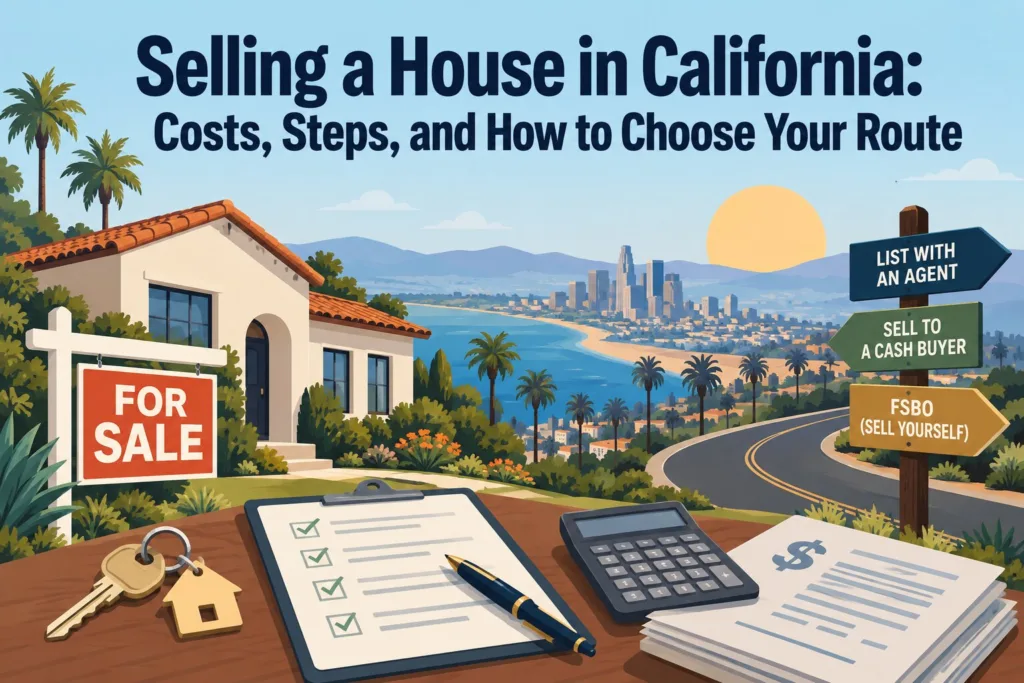
FAST ANSWER: Selling a house in California means choosing between three routes – a listing agent, selling by owner (FSBO), or a direct cash sale. Each trades price against time differently. A traditional agent sale runs about 6% to 8% of the price in costs and takes roughly two months from listing to close. FSBO saves most of that cost, but adds the work yourself. A direct cash sale skips both and can close in as few as 7 days.
Selling a house in California comes down to one real decision: which of three routes fits your timeline, your home’s condition, and how much of the process you want to handle yourself.
An agent typically gets you the highest price but takes the longest and costs the most. Selling FSBO keeps the commission in your pocket, provided you have time to manage pricing, marketing, and paperwork on your own. A direct cash sale trades some of that price for speed – no listing, no showings, no financing risk.
Whichever route you’re leaning toward, the same handful of numbers drive the decision: what it actually costs, how long each option realistically takes, and what you give up or gain by skipping the traditional process.
lightbulbKey Takeaways
check_circle
Selling with a traditional agent in California costs about 6% to 8% of the sale price in commission and closing costs combined – commission alone averaged 5.08% in August 2026 (Clever Real Estate agent survey).
check_circle
California homes sold in a statewide median of 28 days in August 2026, and escrow typically adds another 30 to 45 days before the sale actually closes (C.A.R.).
check_circle
Every seller – agent, FSBO, or cash – fills out the same two standard forms: a Transfer Disclosure Statement and a Natural Hazard Disclosure.
check_circle
The right route depends on what you’re optimizing for: an agent for the highest likely price, FSBO for saved commission if you have the time, or a direct cash sale for speed and certainty.
check_circle
A direct cash sale can close in as few as 7 days and removes repairs, showings, and financing fall-through risk, in exchange for a price below what a listed, market-ready home would fetch.
Selling with a real estate agent in California typically costs 6% to 8% of the sale price once commission is included, or roughly 1% to 3% without it. Commission is the biggest line. It averaged 5.08% of the price in August 2026, split about 2.57% to the listing agent and 2.51% to the buyer’s agent (Clever Real Estate), with escrow fees, title insurance, and transfer tax making up most of the rest. On an $800,000 home, that puts commission alone at roughly $40,000 to $48,000.
Selling FSBO or to a direct cash buyer changes which of those costs apply. FSBO sellers skip the listing-side commission but still budget for a flat-fee MLS listing and their own marketing. A direct cash sale removes commission and most closing fees entirely.
For the full line-by-line breakdown, including escrow formulas, title insurance ranges, and who customarily pays what, see how much closing costs run in California and how commission actually works.
Selling a house in California follows the same six steps whether you hire an agent, go FSBO, or sell directly. Only the amount of work you personally do in each one changes.
Pull a comparative market analysis (CMA), an online valuation, or a professional appraisal. Price varies sharply by location, lot size, renovations, and local demand, so a number based on recent nearby sales beats a county tax-assessed value, which can lag the market by years.
Most California sellers complete a Transfer Disclosure Statement covering known issues with the property, and a Natural Hazard Disclosure covering flood, fire, and earthquake zones. Homes built before 1978 also need a short lead-paint disclosure. Your escrow company will walk you through exactly which ones apply to your sale.
A listing agent brings marketing and negotiation support for 5%–6% in commission; FSBO saves that fee but adds legal and logistical work; a direct cash sale is fastest if you’d rather skip repairs, showings, and closing costs altogether.
See our FSBO checklist if you’re leaning that way.
Repairs, deep cleaning, and staging vary by budget and home condition. A 2025 Bankrate report put average California staging costs at $837 to $2,924, averaging $1,844 – costs a direct, as-is sale avoids entirely.
Weigh price against contingencies, financing terms, and the buyer’s proposed closing date. Traditional negotiations can stretch for weeks, and financing- or inspection-related fall-throughs are among the most common reasons deals collapse.
The final stage covers inspections, document signing, and fund transfer through escrow. Traditional closings commonly face delays from loan approvals or title issues; a cash sale removes financing from the equation entirely.
| Route | Best If | Main Trade-off |
| Agent | You want the highest likely price and can wait out a roughly two-month process | You pay commission and handle repairs, staging, and showings along the way |
| FSBO | Your home is in good shape, and you have the time to manage pricing, marketing, and paperwork yourself | You keep the commission, but take on all the work an agent would normally do |
| Direct Cash Sale | You need to close fast, the home needs work, or you’d rather skip showings and financing risk | You trade some sale price for speed and certainty |
An agent makes the most sense when your home is in good condition, you’re not in a rush, and getting the highest possible price matters more than how long it takes to get there. You’ll pay commission and put in some work preparing the home, but an agent’s marketing reach and negotiating experience are built for that outcome.
FSBO fits sellers who have the time and confidence to handle pricing, marketing, and buyer negotiations themselves. It saves the listing-side commission, but mainly pays off if your home doesn’t need much work to attract buyers on its own — without an agent’s network behind it, a home that needs convincing can sit for a while.
A direct cash sale is the better fit when speed matters more than squeezing out the last dollar. This can be a tight timeline, a home that needs repairs you’d rather not make, or simply wanting to skip showings and the risk of a buyer’s financing falling through. You’ll typically net less than full market value, but you know the number and the closing date going in.
This isn’t a one-way decision. Sellers who start FSBO or with an agent often keep a cash offer as a fallback if the home doesn’t sell within a set window.
A traditional sale in California takes roughly two months from listing to close, though the timeline shifts with route and market conditions. Statewide, single-family homes sold in a median of 28 days in August 2026, according to the California Association of Realtors – down from 31 days a year earlier. Once a buyer is under contract, escrow commonly adds another 30 to 45 days before the deal actually closes, so a listed home typically takes about 60 to 75 days start to finish.
FSBO timelines vary more, since they depend on your own marketing reach rather than an agent’s buyer network and full MLS exposure; without that, a FSBO listing can sit longer even when it’s priced correctly. A direct cash sale skips the market-timing question entirely. Osborne Homes, for example, can close in as few as 7 days from an accepted offer, regardless of how fast or slow homes are moving in your area that month.
Here’s how the three routes compare on the factors that matter most to California sellers.
| Factor | Agent | FSBO | Direct Cash Sale |
| Time to close | ~28-day median to find a buyer, then 30–45 days to close (C.A.R., Aug 2026) | Often slower without MLS/agent reach | As few as 7 days from accepted offer |
| Cost/commission | ~5.08% combined, avg. (Clever, Aug 2026) | None owed, though you may still cover the buyer’s agent fee | None |
| Repairs | Often expected before listing | Your responsibility and cost | Sold as-is; no repairs or staging |
| Showings | Agent manages showings and open houses | You schedule and host them yourself | One walkthrough, no repeat showings |
| Price achieved | Typically closer to market value | Depends on your pricing and marketing | Below retail, reflecting speed and certainty |
| Certainty | Same financing risk as any buyer-financed sale | Same financing risk as any buyer-financed sale | None – cash purchase |
Osborne Homes is a California real estate investment company that has purchased more than 3,000 homes directly across the state since 2007, including plenty of traditional listings and FSBO sales that stalled over financing or a missed disclosure. If certainty matters more than squeezing out the last dollar, that direct-sale column is worth pricing against your own home before you commit to a listing.
Selling with an agent typically costs 6% to 8% of the sale price, including roughly 5.08% in combined commission plus escrow, title, and transfer-tax fees. Without commission, so in the FSBO or cash sale routes, costs drop to around 1% to 3% or less. See our full closing cost breakdown for the line-by-line numbers.
Statewide, homes sold in a median of 28 days in August 2026, then took another 30 to 45 days to close through escrow – about two months total for a traditional sale. FSBO timelines vary more without an agent’s buyer network. A direct cash sale can close in as few as 7 days from an accepted offer.
Selling directly to a cash buyer removes commission and most closing fees entirely, making it the lowest-cost route on paper. FSBO is the cheapest way to sell at or near market value, since it avoids the listing-side commission while still aiming for a traditional sale price.
No. You’re not required to make repairs before you sell, but buyers using a loan will often ask for some after inspection, and their lender may hold up financing over major issues. Selling as-is to a direct cash buyer skips that back-and-forth entirely.
Most sellers fill out a Transfer Disclosure Statement and a Natural Hazard Disclosure, plus a lead-based paint disclosure for homes built before 1978. These apply whether or not you use an agent, and your escrow company will walk you through anything specific to your property.
It depends on what you’re optimizing for. An agent typically nets a higher sale price but takes about two months and comes with commission, repairs, and financing risk. A direct cash buyer closes in as few as 7 days with no repairs or showings, trading some price for speed and certainty — worth comparing directly against your own numbers before you list.
Every route above gets you to a closed sale; the difference is what you pay in time, money, or certainty to get there. If speed and a guaranteed closing date matter more than chasing the last dollar, Osborne Homes can make a no-obligation cash offer and close in as few as 7 days – a number worth having even if you end up listing instead.

The Osborne Homes Team
The Osborne Homes team specializes in California real estate, helping buyers, sellers, and homeowners navigate the market with clarity and confidence. Our articles are written to provide practical guidance, local insight, and up-to-date information you can trust.
Get a no-obligation cash offer in as little as 48 hours. No repairs, no agents, no stress. Just a dignified way to move forward.
Free property assessment. No obligation. No pressure.
sell